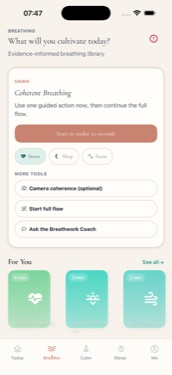
Browse by moment
Quick-pick by symptom
If you're scanning fast:
- Heart racing, can't think straight → one physiological sigh. Then breathe normally for 30 seconds. If still elevated, do five minutes of cyclic sighing.
- Can't sleep, mind spiraling → 4-7-8 breathing or cyclic sighing while lying still. Don't check the clock.
- About to do something stressful that needs composure → box breathing for 3-5 minutes.
- Need to focus for a long task → alternate nostril breathing or coherent breathing at 0.1 Hz for 5-10 minutes.
- Feeling overstimulated, sensory overload → diaphragmatic breathing with a longer exhale than inhale.
- Drifting off to sleep → sleep ladder 3-6-9 with brown noise underneath (why brown noise).
When breathwork is not the answer
Breathwork is optional and individual responses vary; it is not a substitute for clinical care. If you experience recurring panic symptoms, persistent insomnia, suicidal thoughts, or symptoms that disrupt daily life, contact a qualified clinician. A breathing app is a wellness tool, not a treatment. Privacy architecture matters, but it does not replace professional support.
Where PulseWave fits
Every pattern mentioned on this page is documented in the current PulseWave repository with guided pacing and haptic timing; the current Store entitlements are shown on PulseWave live App Store sheet. AI inference runs on the phone, so prompts are not transmitted to an external model provider. The underlying journal, mood and eligible practice records can be stored in an authenticated per-user Firestore record under an anonymous or linked user ID. Confirm the shipping behaviour on the live Store sheet. See how the on-device AI works or the privacy architecture comparison.
FAQ
There is no universally best breathing technique or guaranteed way back to sleep. Keep stimulation low and try comfortable slow breathing only if it feels helpful. Repeated wake-ups or daytime impairment warrant professional advice; a 28-day cyclic-sighing study did not test insomnia or 3am sessions. See the night-waking scenario.
If deliberate breathing feels comfortable, try a gentle equal-count pattern for a few minutes. Box breathing's operational use is not direct proof of a pre-performance benefit, and breath holds are not suitable for everyone. Your preparation remains the main performance tool.
Create a short pause: one comfortable breath, look into the distance, then write down one next action. A breathing app cannot fix workload, management or burnout, and no routine guarantees clarity. See the workday scenario.
Use caution. Some people find gentle, unforced pacing useful; others become more focused on symptoms. Avoid repeated oversized breaths and stop if deliberate breathing makes symptoms worse. New, severe or unusual symptoms require urgent medical assessment, and recurring panic belongs with a qualified clinician. See the panic-symptom safety page.