What alternate nostril breathing actually is
Three things happen at once when you do Nadi Shodhana, and they explain why the numbers move.
First: the displayed cadence slows breathing. Studies of slow paced breathing report HRV and other outcomes under particular conditions, but an individual's resonance rate varies. The literature does not prove that pacing alone supplies most of any alternate-nostril effect.
Second: the act of closing one nostril physically increases nasal airflow resistance on the open side, which engages slow diaphragmatic breathing more deeply than unrestricted breathing typically does. People over-recruit accessory respiratory muscles when they breathe freely; the one-nostril restriction quietly forces a better breathing mechanic.
Third: the nasal cycle is a real alternation in airflow dominance, but that does not establish a simple left-parasympathetic/right-sympathetic switch. Studies of unilateral or alternate-nostril breathing are generally small and heterogeneous. Their findings should not be used to predict an individual autonomic response from a five-minute session.
How to do alternate nostril breathing (step by step)
-
STEP 01
Close right · inhale left · 4 sec
Right thumb gently closes the right nostril. Slow nasal inhale through the left, counting to four.
-
STEP 02
Switch · exhale right · 4 sec
Release the thumb, close the left nostril with the ring finger. Slow nasal exhale through the right, counting to four.
-
STEP 03
Inhale right · 4 sec
Left nostril still closed. Slow nasal inhale through the right, counting to four.
-
STEP 04
Switch · exhale left · 4 sec
Release the ring finger, close the right with the thumb. Slow nasal exhale through the left, counting to four. That's one full round.
Repeat for 5 to 10 minutes. About 18 to 22 rounds per session at the 4-4 cadence.
Follow the ring
Each phase tells you which nostril is open. Your hand does the closing.
16-second round · ~3.75 rounds per minute. The app cues the side switch with a tap on each transition.
What the research actually says
Alternate nostril breathing has a peer-reviewed evidence base, but many studies are small, single-site and conducted in non-clinical populations. Protocols and outcomes vary, so the literature is better described as suggestive than as a settled effect on HRV, blood pressure or attention.
Telles et al. (2017) reported within-study blood-pressure and vigilance results after a 30-minute session in 24 participants. Other small studies have reported autonomic or cardiovascular measures. Those findings should be read in their original populations and designs; they are not direct evidence for PulseWave or for a consumer session of another length.
The honest summary: the research is interesting but not robust enough to predict an individual autonomic, attention or clinical effect. Use the technique as an optional practice, not as a treatment, and judge comfort rather than trying to reproduce a published number.
Alternate-Nostril Yoga Breathing Reduced Blood Pressure While Increasing Performance in a Vigilance Test
When to use alternate nostril breathing
- Before tasks needing sustained attention — long reading, deep work, exam preparation, anything where mind-wandering will cost you.
- As a transition between intense activity and rest — after a workout, after a stressful call, before a difficult conversation.
- As a daily morning practice — five to ten comfortable minutes if you enjoy the structure; published studies do not guarantee cumulative benefits.
- When two-nostril slow breathing feels too easy — the side-switch and hand work occupy enough attention that the practice stays engaging beyond the first week.
- Before sleep — if comfortable, use an unforced cadence as a bedtime cue; no particular autonomic or sleep outcome is guaranteed.
How PulseWave makes it easier
The pacer handles the timing and the side switch. Your hand does the closing.
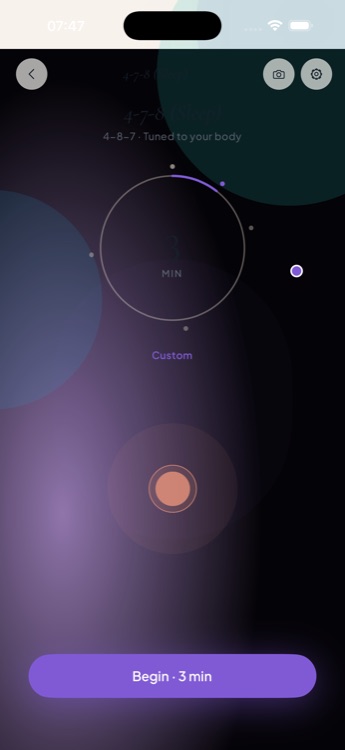
The trickiest part of alternate nostril breathing is keeping the side rhythm right while also keeping the breath slow — most people lose the pattern around minute three. PulseWave cues both the breath timing and the side switch with a visual ring and a haptic tap, so you can close your eyes and let the side change tell you what to do.
- Per-side count adjustment — symmetrical (4-4) or exhale-weighted (4-6) per side.
- Side-switch haptic — one tap on each transition, even with the screen off.
- 3 to 20-minute sessions — pick a duration; rounds count cleanly to the end.
- Background audio — pair with an alpha brainwave preset from the sound studio.
- Current App Store offer — no account and offline pacing for this practice; verify the final entitlement on the live App Store sheet.
FAQ
Alternate nostril breathing — Nadi Shodhana in Sanskrit — is a yogic pranayama in which you breathe through one nostril at a time, alternating sides between each inhale and exhale by closing the other nostril with the fingers. PulseWave default cadence is a 4-second inhale and 4-second exhale per side, no retention, which is the safe beginner version. More advanced variants add timed holds at the top of the inhale.
It is a structured attention and breathing practice from yoga. Small studies have reported changes in autonomic, blood-pressure or attention measures under specific conditions, but results are heterogeneous and do not predict what an individual will feel.
No broad claim is scientifically proven. Peer-reviewed studies exist, but many are small, single-site and use different protocols or outcomes. Treat their findings as suggestive adjacent evidence, not proof of a clinical benefit or a guaranteed autonomic effect.
Five minutes is a useful first dose; ten minutes is the duration most published studies have used. Daily practice is more useful than long but rare sessions. Inside PulseWave, sessions run from 3 to 20 minutes with adjustable per-side counts.
The traditional technique uses fingers to alternate nostril closure. Imagining a side switch without closure is a different attention exercise and should not be assumed to retain a focus benefit or physiological effect. Skip nostril closure with injury or significant congestion.