What the physiological sigh actually is
Alveoli are tiny air sacs involved in gas exchange. Spontaneous sighs have a role in respiratory physiology, but a consumer guide should not infer that posture or stress has collapsed a reader's alveoli, changed blood carbon dioxide or caused a feeling of tightness. New or persistent chest tightness requires medical assessment.
The mammalian body solves this with sighs. A 2016 paper by Li, Feldman and colleagues in Nature identified the specific cluster of neurons in the brainstem (in the pre-Bötzinger complex) that generate sighs as a distinct breathing pattern — and showed that mammals deprived of these neurons stop sighing. Sighs aren't a luxury or emotional artifact; they are mechanically required to keep the lungs working efficiently. You take about a dozen of them every hour, mostly unconsciously.
The deliberate practice borrows the double-inhale-long-exhale shape of a sigh. Respiratory research helps explain the role of sighs in lung function, while Balban et al. studied repeated five-minute daily practices. Neither establishes that one deliberate breath “pops” alveoli open, follows a single vagal pathway or reliably creates a stress reset.
How to do a physiological sigh (step by step)
-
STEP 01
Inhale 1 · nose · ~2 sec
Slow nasal inhale, filling the lower lungs first. Don't max out — leave room.
-
STEP 02
Inhale 2 · nose · ~1 sec
Without exhaling, sneak a second smaller inhale on top. This is the alveoli pop. Most people miss this and it's the part that does the work.
-
STEP 03
Exhale · mouth · 5–8 sec
Long slow exhale through pursed lips. Make it audibly slow. Let the breath finish completely.
One sigh is one cycle. Use one in the moment; if you want a longer practice, repeat for five minutes — that's cyclic sighing.
Follow the ring
One cycle: short inhale, top-up inhale, long exhale.
10-second cycle · do one, then breathe normally. Don't chain sighs back-to-back outside a guided cyclic-sighing session.
What the research actually says
Two distinct literatures are relevant: spontaneous sigh physiology and deliberate repeated cyclic-sighing practice. Neither alone proves a one-breath stress-reset claim.
Li et al. (2016) identified a neural circuit involved in generating sighs in mice. That basic-science result helps explain sigh generation; it is not a clinical validation of a deliberate one-breath intervention in humans.
Balban et al. (2023) tested five-minute daily breathing practices over 28 days and reported group-level outcomes in positive affect, anxiety and respiratory rate. That design did not test one deliberate sigh, an acute emergency tool, or PulseWave. Personal reports may be useful for preference, but they are not efficacy evidence.
The honest summary: spontaneous sigh physiology and a 28-day cyclic-sighing trial are relevant but distinct evidence. The one-breath wellness use has not been established in a dedicated RCT. Treat it as an optional, comfortable cue — not a proven, universally safe or fast stress intervention.
The peptidergic control circuit for sighing
When to use a physiological sigh
- Mid-stress, in the moment — about to walk into a hard meeting, just got an angry email, kid melting down, traffic. One sigh, then continue.
- Transition moments — between calls, after a workout, before a difficult conversation. A single sigh as a punctuation mark.
- When you notice shallow breath — you've been holding your breath at your desk for ten minutes. Sigh, then resume.
- Before sleep — a comfortable sigh can be used as a transition cue, but it is not proven to shorten sleep onset.
- As a longer practice — use cyclic sighing for five minutes; that's the version with the marquee RCT.
How PulseWave makes it easier
A 60-second guided sigh — and a doorway into the 5-minute practice.
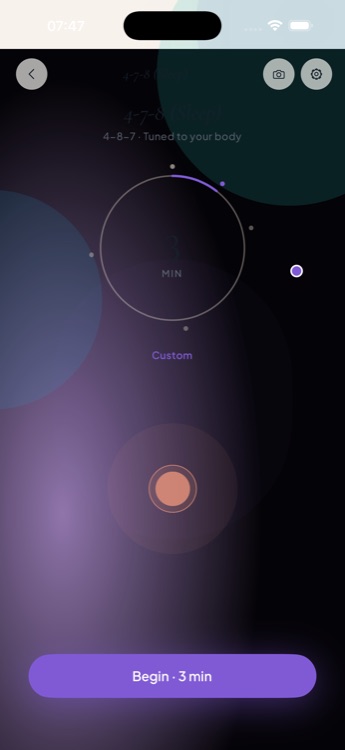
PulseWave session player handles both: a single guided sigh for in-the-moment use (the rare app feature for a single-breath protocol), and a structured five-minute cyclic-sighing session when you want the longer practice. The visual pacer gives the second top-up inhale its own beat, which is the part most people forget when they try to do it from memory.
- Single-breath SOS — open the app, tap, exhale, you're done in 10 seconds.
- 5-minute cyclic-sighing session — for the longer practice with the Balban-et-al evidence base.
- Haptic pacer — feel the second inhale's transition. No screen required.
- Background audio — pair with the sound studio for a quieter context.
- Current App Store offer — no account and offline pacing for this practice; verify the final entitlement on the live App Store sheet.
FAQ
A sigh is a respiratory pattern with a larger breath that helps maintain lung function. The deliberate version commonly taught as a physiological sigh uses a short inhale, a second inhale and a longer exhale. Research on spontaneous sigh physiology does not prove that one deliberate cycle rapidly reduces stress.
A physiological sigh usually refers to one double-inhale-long-exhale cycle. Cyclic sighing repeats a similar pattern for several minutes. Balban et al. (2023) studied daily five-minute practices over 28 days; it did not test a one-breath stress reset.
No. The reflex was studied long before its recent popularisation. Li et al. (2016) identified a sigh-related neural circuit in mice. Huberman later popularised the deliberate pattern and co-authored Balban et al.'s human trial of repeated daily cyclic sighing; that trial did not test a one-breath reset.
There is no universal consumer dose. Try a single comfortable cycle and avoid repeated oversized breaths. Stop if you feel dizzy, breathless, tingly or more anxious, and seek professional advice if you have relevant respiratory, cardiac or panic-related concerns.
PulseWave cues gentle nasal inhales and a comfortable mouth exhale, but the route is a practice instruction rather than a proven requirement for a stress outcome. Do not force depth or duration.