What "resonance" actually means here
Your heart rate doesn't stay flat. Every breath nudges it up on the inhale and down on the exhale — a phenomenon called respiratory sinus arrhythmia. At normal breathing rates, this nudge is small. But there's one rate where the system enters resonance: where the heart's own baroreflex rhythm syncs up with the breathing rhythm and the heart rate swings grow in amplitude. That rate, for most adults, sits between five and seven breaths per minute.
Breathing near an individual's resonance frequency can produce large heart-rate oscillations in HRV-biofeedback settings. HRV is context-sensitive, consumer devices differ, and a higher reading should not be interpreted here as proof of recovery capacity, emotional regulation or clinical benefit.
How to do coherent breathing
- STEP 01
Settle
Sit upright. Mouth closed. Hand on belly to feel diaphragmatic motion.
- STEP 02
Inhale · 5 sec
Nasal inhale, smooth and even, belly first then chest.
- STEP 03
Exhale · 5 sec
Smooth nasal or mouth exhale, same duration as the inhale.
- STEP 04
Hold the rate
Smooth wave. No holds. No effort. Five-in, five-out, repeat.
5 to 20 minutes. Twenty is the dose used in most published studies.
Coherent breathing timer
Inhale 5 · exhale 5, no holds. One round lasts 10 seconds: six breaths per minute.
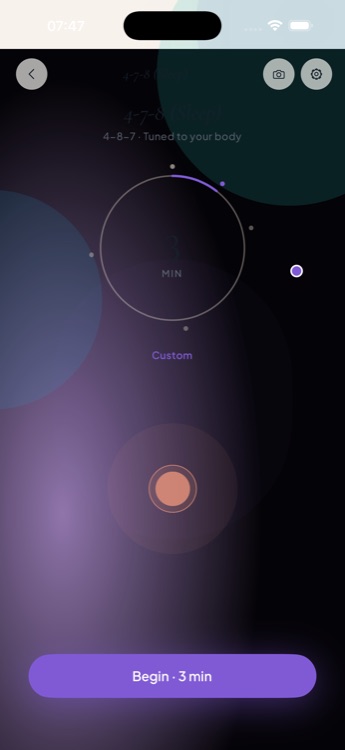
Want coherent 6-6, box 4-4-4-4, 4-7-8, cyclic sighing or your own timing? Open the breathing timer.
Keep going on your phone: every breathing pattern is free in PulseWave.
What the evidence does — and does not — establish
Heart-rate-variability biofeedback at an assessed resonance frequency has been studied for decades. That literature is broader than research on the consumer label “coherent breathing,” and protocols, populations and outcomes vary. The review below explains the proposed feedback model; it is not direct evidence for PulseWave.
For this page, the evidence supports describing a commonly studied rate range and an adjacent HRV-biofeedback rationale. It does not support promising treatment, a universal six-breath optimum or a specific result from an app-guided session.
Heart rate variability biofeedback: how and why does it work?
When coherent breathing is the right tool
- Daily paced-breathing practice — choose a comfortable duration; this is not a prescribed autonomic workout.
- Pre-sleep wind-down — combined with a sound-studio Delta preset and dim lights.
- Anxiety management programs — see the 10-Day Anxiety Ease program.
- Recovery sessions for athletes — between training blocks; before sleep on heavy days.
- HRV biofeedback work — pair with a chest strap to actually see the resonance form.
How PulseWave makes it easier
Hold the exact rate. Twenty minutes feels like ten.
The hardest part of coherent breathing isn't the technique — it's holding the rate steady for twenty minutes without drifting back to your default. The pacer does that work for you. Optional sound studio overlay turns it into a meditative state instead of a chore.
- 5-5 default · 6-6 and 4-6 variants — match your individual resonance.
- Visual + haptic pacer — screen-free practice.
- 20-minute clinical dose — plus 5 and 10-minute options.
- Sound studio overlay — pair with Alpha or Theta brainwave presets.
- Pairs with guided audio and haptics so you can follow the cadence without watching the screen.
FAQ
In HRV biofeedback, resonance frequency is an individually assessed breathing rate that can produce large heart-rate oscillations through interactions among breathing, heart rate and the baroreflex. It is often near 0.1 Hz, but it varies and should not be treated as exactly six breaths per minute for everyone.
Six breaths per minute is a convenient starting rate near 0.1 Hz. HRV biofeedback studies examine changes in physiological measures at or near an individual's resonance frequency; this does not guarantee calm, recovery or emotional-regulation benefits for every person.
No. Published HRV-biofeedback protocols assess individual resonance frequency, which can vary. Six breaths per minute is a general practice setting, not a personalised measurement.
Study protocols vary. PulseWave offers 5, 10 and 20-minute sessions for convenience, not as prescribed clinical doses. Start gently, do not force slow breathing and stop if you feel dizzy, breathless or uncomfortable.
No. HeartMath is a separate branded system with its own devices, terminology and exercises. PulseWave is not affiliated with or endorsed by HeartMath.