What "real-time synthesis" actually means
Most sleep apps work by streaming or playing back pre-rendered audio files. That's fine for nature sounds and simple ambient loops, but it limits what you can do — every layer is fixed, every frequency is baked in, every change requires downloading a new file. PulseWave generates the audio on the fly using the phone's audio processing graph. Change the binaural offset by 0.2 Hz and the sound updates immediately. Adjust the EQ and you're hearing the new shape inside a frame.
The practical upside is that you stop being a passive consumer of someone else's mix and start shaping the actual sound to your room, your headphones, and what your brain is asking for at the moment. The downside is that it asks you to learn one knob at a time. The brainwave presets exist for the days you don't want to.
Brainwave presets
Delta · 0.5–4 Hz→
Deep sleep frequency. Use as a background layer once you're in bed.
Theta · 4–8 Hz→
Deep meditation, NSDR, hypnagogic transition.
Alpha · 8–13 Hz→
Relaxed alertness. Useful during low-stakes focused work.
Beta · 13–30 Hz→
Active concentration. Pair with longer breathing protocols for deep work.
Gamma · 30–100 Hz→
Peak performance band. Use sparingly — high frequencies can feel grating without the right EQ.
Built-in ambient tracks
For users who want the synthesis without dialling it themselves, the library includes pre-built tracks at known brainwave frequencies, plus standard nature sounds and noise types.
Alpha Waves · 10 Hz→
Specific frequency in the Alpha band. Useful as a working background.
Theta Waves · 6 Hz→
Meditation depth, NSDR onboarding.
Delta Waves · 3 Hz→
Sleep background. Best with side-sleeper earbuds.
Rain · Ocean · Forest · Fire→
Procedural nature tracks. Generated, not looped — never repeats audibly.
Pink · Brown · White Noise→
Standard noise types. Brown noise is the sleep-favourite.
Custom Sound Creator — build and save your own
This is the studio's deeper end and where most long-term users end up living. Open the Custom Sound Creator and you get the same engine the presets run on, exposed for you to configure. Pick the base sound (brown, pink, white, grey, rain, ocean — your choice). Push it through wave modulation. Add a binaural offset with independent left/right carriers. Stack an isochronic-pulse layer on top. Shape the lot with a global 5-band parametric EQ. When something sounds the way you want, name it and save it — there is no cap on the number of presets you can keep.
Per-track controls
- Base sound — choose the source (noise type, nature track, tonal generator) and tune its density or impact parameter.
- Wave modulation — speed and depth, for slow drift or tighter pulse.
- Binaural offset — independent carrier frequencies on the left and right channels for hemispheric entrainment.
- Isochronic pulses — amplitude modulation at your chosen rate, layered on top of the carrier.
- Master volume — per-track gain so the mix sits where you want it.
Global controls
- 5-band parametric EQ — shape the combined output without going back into each track.
- Brainwave preset chips — Delta · Theta · Alpha · Beta · Gamma. Tap to anchor a track at a known band, then refine.
- Sleep timer + fade-out — set the fade curve from one minute to thirty.
Saving and reusing your work
Every mix can be saved, named, given an optional emoji and reopened later. The current repository can cache presets locally and write them to the authenticated per-user Firestore record under an anonymous or linked user ID; preset content is not sent as analytics. Final limits and entitlements remain subject to the live Store version.
A few patterns we see in real use: a focus mix with brown noise plus a 10 Hz Alpha binaural on track two. A sleep mix with rain plus a 3 Hz Delta layer and the EQ rolled off above 4 kHz. A meditation mix with Tibetan-bowl-like tones and a slow 6 Hz isochronic pulse. None of these are presets we ship — they are what people build and rebuild because they sound right to their ears.
Sleep Journeys
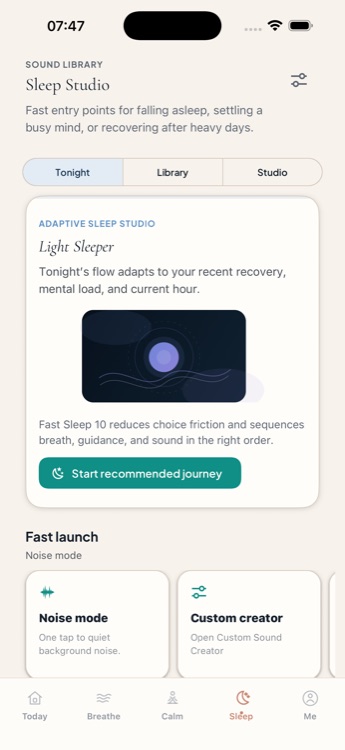
Where the studio meets a guided session. A Sleep Journey is a single tap that runs a breath reset, a guided session, and a 10-to-45-minute ambient wind-down sequenced together. Narrated in English, French and Spanish. Three depth options: Fast Sleep (10 min), Late Mind Reset (20 min), and Deep Recovery (45 min).
An honest note on binaural beats and the evidence
Brainwave entrainment through binaural and isochronic stimulation has a real but mixed evidence base. Some studies show subjective effects on mood and perceived focus; others show no measurable change in EEG. Most reviewers conclude the effect is real but modest, and the subjective experience of the sound itself plays a meaningful role independent of any neural entrainment. The PulseWave position: use them because you like how they sound and how they feel; treat any larger claim with appropriate skepticism. The synthesis engine is there because it gives you control, not because we're promising specific neurological outcomes.
How PulseWave runs the studio
A timeline mixer, not a media player.
Save your presets. Layer your tracks. Set sleep timers and crossfades. Run the studio in the background while another protocol or meditation plays in the foreground. Standard music app shortcuts work — lock screen controls, Apple Watch, AirPods.
- Custom presets — up to 20 in the current repository, saved to the authenticated per-user Firestore record with offline write support.
- Layer with breathing or meditation — runs alongside any session.
- Sleep timer · auto-fade — fades out at your selected interval.
- Lock-screen + AirPods — standard control surface.
- Planned Premium — the repository currently assigns the full custom builder and offline content packs here; verify the shipping entitlement in the live Store sheet.