What box breathing actually is
Strip away the brand and box breathing is just slow paced breathing with two added holds — one at the top of the inhale, one at the bottom of the exhale. The holds are what give it the "box" shape and what separate it from rhythmic breathing patterns that simply alternate in-and-out.
At the displayed counts, breathing slows and the equal cadence gives attention a clear place to sit. Individual resonance frequency varies, and the added holds make this pattern distinct from the continuous breathing used in much of the adjacent research. PulseWave therefore does not infer a specific baroreceptor, chemoreceptor or emotional outcome from the timing alone.
How to do box breathing (step by step)
-
STEP 01
Inhale · 4 sec
Slow nasal inhale, counting steadily to four. Don't rush; don't max out the lungs.
-
STEP 02
Hold · 4 sec
Soft hold at the top. Throat open. Not a Valsalva strain.
-
STEP 03
Exhale · 4 sec
Slow mouth exhale, counting to four. Let the breath finish completely.
-
STEP 04
Hold empty · 4 sec
Bottom hold. This one is the one most apps skip. Don't.
Repeat for 4 to 20 minutes. Five minutes is a good first dose.
Box breathing timer
Inhale 4 · hold 4 · exhale 4 · hold empty 4. One round lasts 16 seconds, about four rounds per minute.
Want 4-7-8, coherent 5-5 and 6-6, cyclic sighing or your own timing? Open the breathing timer.
Keep going on your phone: every breathing pattern is free in PulseWave.
What the research actually says
Box breathing sits in an awkward spot in the evidence map. The exact equal-count pattern with holds lacks the kind of direct randomized trial available for some other practices. Studies of continuous slow paced breathing report various HRV, autonomic and self-reported outcomes under specific conditions, but those adjacent findings do not validate box breathing or its holds.
The honest summary: box breathing is a widely used practice with adjacent evidence from other slow paced breathing protocols. Professional or military use is not proof of efficacy, and research on the exact equal-count pattern remains limited. PulseWave therefore presents it as an optional pacing technique, not a proven outcome or a clinical intervention.
The effects of resonance frequency breathing on autonomic balance, emotion and cognition
When to use box breathing
- Before sustained-focus blocks — long writing session, deep code review, intricate surgical or technical work.
- Before high-pressure performances — talks, negotiations, recitals, courtroom appearances.
- In transition periods — between meetings, between client calls, between a workday and the evening at home.
- During long-duration stress — when something is going to be hard for an hour, not just two minutes.
- As a sleep onboarding ramp — drop to 4-6-8-2 or similar exhale-heavy variants inside the app.
How PulseWave makes it easier
A visual pacer plus haptics, so your eyes can close.
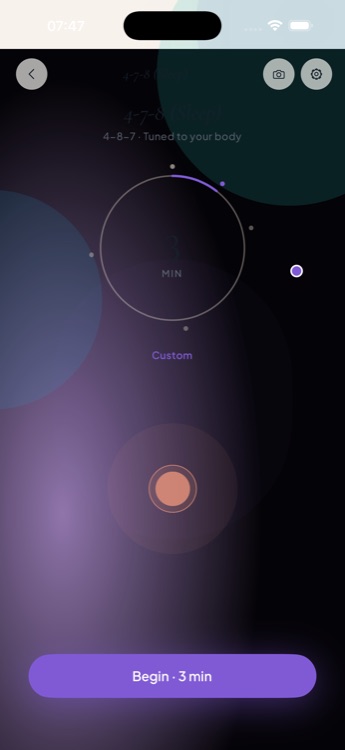
Counting in your head is fine until something else needs your attention. PulseWave runs the cadence for you, with a visual ring at the top of the screen and an optional haptic tap at each transition. Set the four phase lengths independently if 4-4-4-4 isn't quite right for your breath length.
- Adjustable counts — 4-4-4-4 to 6-6-6-6 and exhale-weighted variants.
- Haptic transitions — one tap at each phase change. No screen required.
- 4 to 20-minute sessions — pick a duration; it loops cleanly.
- Background audio — pair with a brainwave preset from the sound studio.
- Current App Store offer — no account and offline pacing for this practice; verify the final entitlement on the live App Store sheet.
FAQ
Inhale through the nose for four seconds, hold for four, exhale for four and hold empty for four: one round takes 16 seconds. PulseWave's box breathing pattern uses these 4-4-4-4 counts. Shorten or remove the holds if they feel strained.
The technique was popularised by former Navy SEAL commander Mark Divine, who used equal-ratio breathing as a tool for stress regulation under operational pressure. Its mechanics are common across many older breathwork lineages — equal-count breathing exists in yogic Sama Vritti and in various Buddhist and Sufi contemplative practices.
Research on the exact equal-count box pattern is limited. Studies of other slow paced breathing practices provide adjacent evidence about HRV and perceived stress, but cannot be used as direct proof that box breathing works or that a particular count is superior.
They are different practices. Balban et al. studied repeated daily cyclic sighing, while direct evidence for the exact box pattern is limited. Choose by comfort and context rather than assuming one is faster or better; stop if either pattern increases discomfort.
For most healthy adults, no. If you have a respiratory or cardiac condition, are pregnant, or experience dizziness during the holds, drop the holds entirely and just breathe at the 4-second/4-second cadence. Talk to a clinician before adopting breath retention practices if you're unsure.