What is cyclic sighing?
Cyclic sighing — also called the physiological sigh — is a deliberate version of a breath your body already does automatically. When you sleep, when you sob, when you're catching your breath, you produce a short secondary inhale followed by a long exhale. It's how the lungs reset gas exchange after periods of shallow breathing.
Deliberately repeating the pattern creates a structured breathing practice. Slow breathing and sigh physiology are studied in relation to autonomic and respiratory measures, but this page does not reduce the response to a single vagal switch or promise a fast change in heart rate, arousal or mood.
How to do cyclic sighing (step by step)
-
STEP 01
Settle
Sit or lie comfortably. Shoulders relaxed, mouth closed.
-
STEP 02
Inhale (nose)
Slow inhale through your nose until lungs feel about 70% full.
-
STEP 03
Top-up inhale
A sharp second inhale through the nose to fully fill the lungs.
-
STEP 04
Long exhale (mouth)
Exhale through the mouth ~twice as long as the inhales. Empty.
Repeat the cycle for 1 to 5 minutes. Pace by feel — no specific count required.
Follow the orb
Match your breath to the animation. The text below tells you the phase.
9-second cycle · 60 seconds = ~7 rounds. For paced sessions with haptics, use the app.
The science (with citation)
In a randomized controlled study published in Cell Reports Medicine in January 2023, Balban and colleagues at Stanford compared three breathing protocols against a mindfulness meditation control. Participants completed five minutes of practice per day for 28 days. Cyclic sighing produced the largest improvements in daily positive affect and the greatest reduction in respiratory rate — both statistically meaningful effects that compounded across the month.
Brief structured respiration practices enhance mood and reduce physiological arousal
One proposed explanation is that the second inhale can recruit additional lung volume before a longer exhale. Balban et al. tested five minutes of daily breathwork over 28 days and reported group-level changes in mood and respiratory rate. That trial did not establish a single vagal mechanism, test PulseWave or show that one minute reliably lowers heart rate or creates relief.
When to use it
- Before a difficult conversation — manager 1:1, hard email, performance review.
- After a stress spike — bad news, near-miss in traffic, frustrating exchange.
- Between focused work blocks — as a 60-second reset rather than scrolling.
- Before sleep — an optional transition cue if it feels comfortable; it is not proven to shorten sleep onset.
- During a mild panic episode — provided you've discussed breathwork with a clinician.
How PulseWave makes it easier
Pacing the breath — without watching a screen.
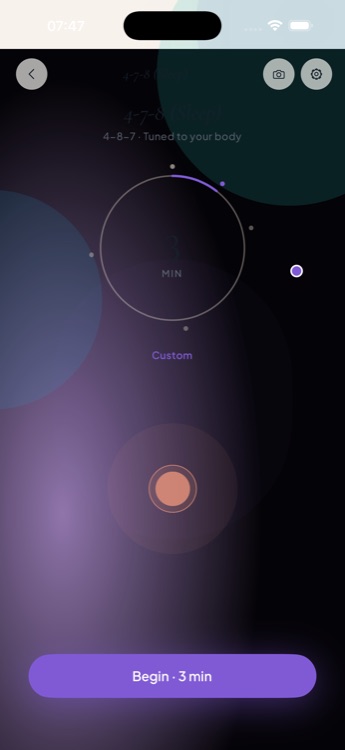
Cyclic sighing is simple. The hard part is the pacing — most people speed up under stress, which collapses the protocol. PulseWave does the timing for you, with three modes you can mix and match.
- Visual orb pacer — synced to the inhale-inhale-exhale rhythm.
- Optional haptic vibration — close your eyes; the phone keeps time.
- 1, 3, 5 and 10-minute sessions — match the protocol or go deeper.
- Citation visible in-session — Balban 2023 referenced inside the app.
- Current App Store offer — no account and offline pacing for this practice; verify the final entitlement on the live App Store sheet.
FAQ
The 2023 study used 5 minutes per day. Even a single 60-second round can produce a noticeable shift in heart rate and arousal. PulseWave offers cyclic sighing sessions from 1 to 10 minutes.
Yes. "Physiological sigh" is the term used by researcher Andrew Huberman; "cyclic sighing" is the term used in the Balban et al. 2023 study. Both describe the same pattern: double inhale through the nose followed by an extended exhale through the mouth.
They are different practices. Balban et al. studied repeated daily cyclic sighing; direct evidence for the exact box pattern is limited. No head-to-head study establishes that one is faster or better for acute stress, focus or performance.
Talk to a clinician before adopting any new breathwork practice if you have asthma, COPD, panic disorder, or any respiratory or cardiac condition. PulseWave is a wellness tool, not a medical device.
A second short inhale can recruit additional lung volume before the exhale. Balban et al. studied repeated daily cyclic sighing over 28 days and reported group-level outcomes; the study does not prove that one double inhale follows a single vagal pathway or will reliably reduce heart rate or arousal.