What 4-7-8 is, and what it isn't
The 4-7-8 pattern asks for one short inhale through the nose, a long hold and a longer exhale through the mouth. The ratio between phases is the defining instruction. Counting may give attention a simple anchor, but the exact cadence has not been shown to trigger a single vagal pathway or interrupt anxiety reliably.
It is not a sleep button. Social-media claims that 4-7-8 causes sleep within sixty seconds are unsupported. Some people use the rhythm as a bedtime cue; individual comfort and response vary, and breath retention can feel unpleasant or dizzying.
How to do 4-7-8 (step by step)
- STEP 01
Settle
Tongue tip behind upper front teeth (Weil's instruction). Mouth closed.
- STEP 02
Inhale · 4
Quiet nasal inhale, counting to four. Not maximal — comfortably full.
- STEP 03
Hold · 7
Soft hold at the top. Throat open. If seven feels long, count quicker.
- STEP 04
Exhale · 8
Whooshing mouth exhale, pursed lips, until empty. Audible is fine.
Repeat for 4 rounds at first, twice a day. Build to 8 rounds over a few weeks.
4-7-8 breathing timer
Inhale through the nose for 4 · hold for 7 · exhale through the mouth for 8. One round lasts 19 seconds; start with four rounds.
Want box 4-4-4-4, coherent 5-5 and 6-6, cyclic sighing or your own timing? Open the breathing timer.
Keep going on your phone: every breathing pattern is free in PulseWave.
What the evidence actually says
The exact 4-7-8 cadence lacks a landmark RCT. Research on other slow paced, exhale-weighted or breath-retention practices is adjacent and heterogeneous; it cannot establish a reliable sympathetic, HRV or baroreflex outcome for this exact count.
Treat 4-7-8 as an easy-to-remember practice to try only if the hold feels comfortable. Personal preference can guide continued use, but it is not evidence that the pattern treats sleep or anxiety.
How breath-control can change your life: a systematic review on psycho-physiological correlates of slow breathing
When 4-7-8 is the right tool
- The bed routine — once you're lying down, lights off, phone face down. Do four rounds.
- After a stressful moment — bad news, near-miss, an exchange you replay too many times. Three rounds will visibly slow your pulse.
- Before sleep onset — pair with a 20-minute 7-Day Better Sleep program day.
- In the car (passenger seat) — before walking into something you don't want to walk into.
- As a craving interrupt — Weil's original framing. Useful for habit-change moments.
How PulseWave makes it easier
Counting falls apart when you're stressed. The app holds it.
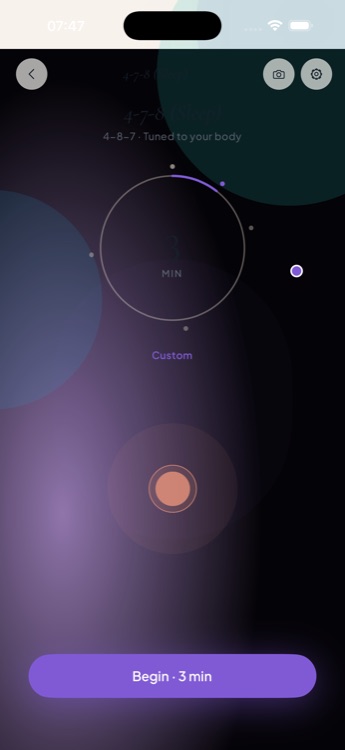
Counting in your head is the first thing to break under load — which is exactly when 4-7-8 is most useful. PulseWave runs the timing for you and lets you tweak the counts if 8-count exhales feel impossibly long when you start.
- Adjustable counts — start at 4-4-6, build to 4-7-8 over a few weeks.
- Visual + haptic pacer — close your eyes; the phone keeps time.
- 2 to 6-minute sessions — four rounds or eight, your call.
- Citation visible in-session — Weil's framing, source linked.
- Current App Store offer — no account and offline pacing for this practice; verify the final entitlement on the live App Store sheet.
FAQ
No. A 60-second sleep claim is not supported by direct evidence. Research on other slow paced or bedtime breathing practices is adjacent and does not prove that the exact 4-7-8 cadence reliably changes heart rate, autonomic state or sleep onset.
Counts in 4-7-8 are relative, not strict seconds. Andrew Weil's original guidance is to use whatever counting pace lets you complete a full breath without strain — so if eight seconds of exhale is too long, count faster. The ratio is what matters: a 1:1.75:2 inhale-to-hold-to-exhale balance.
Dr. Andrew Weil popularised it as a Westernised version of pranayama techniques drawn from yogic traditions, particularly Ujjayi and Anuloma Viloma. The exhale-weighted ratio is the active ingredient; the specific 4-7-8 counts are Weil's framing.
Weil recommends starting with four rounds twice a day and only later increasing to eight per session. Going hard early can produce dizziness, especially during the seven-count hold.
Breath holds may be unsuitable for some people, including those with relevant respiratory, cardiac, pregnancy or panic-related concerns. Ask a qualified clinician before using retention practices. Removing the hold can reduce strain, but no alternative cadence is guaranteed to preserve a specific autonomic benefit.