What diaphragmatic breathing actually is
Your diaphragm is a dome-shaped muscle beneath the lungs. When it contracts, the dome descends and helps draw air in; when it relaxes, it returns upward. Chest and abdominal movement can both be part of normal breathing, and the balance varies with position, effort and health.
Upper-chest or accessory-muscle breathing can occur with exertion, stress, respiratory conditions and many other contexts. A web guide cannot determine whether someone's pattern is inefficient or caused by stress. Persistent breathlessness, pain or a new change in breathing needs clinical assessment.
A short hand-on-belly exercise can help you notice diaphragmatic movement and reduce unnecessary effort. It should not be described as reversing a stress mechanism or activating a specific nerve pathway. Many adults can feel the movement within a few minutes, but comfort and technique vary.
How to do diaphragmatic breathing (step by step)
-
STEP 01
Lie down · one hand chest, one hand belly
On your back, knees bent. One hand flat on the chest, one hand flat on the belly button. This is the only way to verify what's actually moving.
-
STEP 02
Inhale · belly rises · 4 sec
Slow nasal inhale. The belly hand should rise; the chest hand should barely move. Imagine pushing the belly out, gently, against the hand.
-
STEP 03
Exhale · belly softens · 6 sec
Slow mouth or nasal exhale. Let the belly soften and keep the count comfortable; shorten it if needed.
-
STEP 04
Verify · 10 breaths
Belly hand should rise / fall noticeably each breath. Chest hand should move only slightly. If reversed: slow down, push the belly out more deliberately on the inhale.
Practice 5 minutes a day. The goal is to make this the pattern your body falls back into automatically — not just something you can do on command.
Follow the ring
4-second inhale, 6-second exhale. Belly rises on the way in.
10-second cycle · 6 breaths per minute, which is in the resonance-frequency range for HRV.
What the research actually says
Ma et al. (2017) reported attention, affect and salivary-cortisol outcomes after an eight-week intervention in 40 healthy adults. Hopper et al. (2019) reviewed diaphragmatic-breathing studies with varied populations, methods and outcomes. These sources support cautious, study-specific discussion; they do not validate PulseWave, establish one mechanism or guarantee an individual stress response.
Slow paced breathing, respiratory sinus arrhythmia and HRV biofeedback are active areas of research. Diaphragmatic movement is one component of breathing, but the cited studies do not establish a simple chain from diaphragm to vagus nerve to a guaranteed wellness outcome. Individual resonance rates and responses vary.
The honest framing: diaphragmatic breathing is a foundational technique used in many breathing practices. Learning to notice it can make paced exercises easier to follow, but it is not a prerequisite and does not make every other pattern work better.
The Effect of Diaphragmatic Breathing on Attention, Negative Affect and Stress in Healthy Adults
When to use diaphragmatic breathing
- As the foundation, before any other protocol — five minutes of belly breathing, then move into box, 4-7-8, coherent breathing or whatever you came in for.
- To notice and reverse chest breathing — when you catch yourself shallow-breathing at the desk. Hand on belly for thirty seconds; reset.
- As a bedtime cue — try a few unforced breaths if breath focus feels comfortable; this is not proven to shorten sleep onset.
- After illness or surgery — use only the breathing guidance provided by your treating clinician or respiratory physiotherapist.
- As a short awareness practice — a few minutes can help you notice movement without promising an autonomic effect.
How PulseWave makes it easier
A pacer that lets you put both hands on your body.
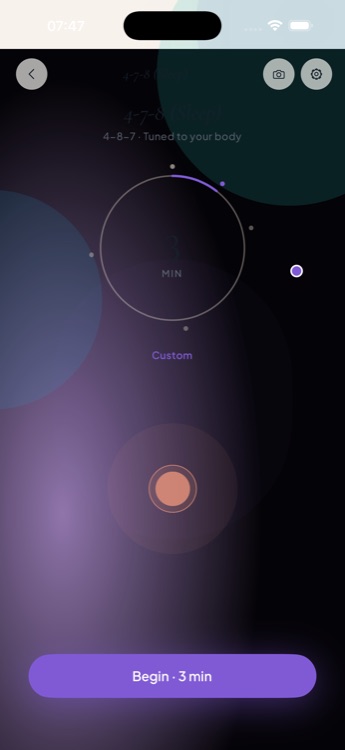
The trick with diaphragmatic breathing is that to learn it, you really do need both hands free to feel the difference between chest and belly. PulseWave haptic pacer means you can close your eyes, put both hands on your body, and let the phone tap out the rhythm — no need to watch a screen or count.
- Adjustable inhale/exhale — start at 4-6, move to 5-7 once it's natural.
- Haptic-only mode — phone face down, hands on body, eyes closed.
- 5 to 20-minute sessions — five minutes is the standard prescription.
- Background audio — pair with a delta or alpha brainwave preset.
- Current App Store offer — no account and offline pacing for this practice; verify the final entitlement on the live App Store sheet.
FAQ
Diaphragmatic breathing — also called belly or abdominal breathing — uses the diaphragm, the dome-shaped muscle beneath the lungs. The abdomen usually expands on inhalation and softens on exhalation, while the chest may also move. The goal is comfortable movement, not forcing the belly or eliminating chest motion.
Lie or sit comfortably and place one hand on the upper chest and one on the abdomen. Notice whether the lower hand moves gently with the breath without trying to immobilize the chest. Technique and mobility vary; pain, marked breathlessness or dizziness are reasons to stop and seek professional advice.
Yes, including an eight-week study in healthy adults and a systematic review. Populations, interventions and outcomes vary, so these sources support cautious discussion of the practice; they do not establish a single mechanism, guarantee stress reduction or provide direct evidence for PulseWave.
There is no universal learning time or required daily dose. Start with a few comfortable breaths and avoid forcing abdominal movement. A respiratory physiotherapist or clinician can provide individualized guidance when illness, surgery, pain or breathing difficulty is involved.
Diaphragmatic breathing describes how the main breathing muscle moves. Box breathing, 4-7-8, cyclic sighing and coherent breathing add particular timing instructions. Direct evidence differs by practice, and diaphragmatic movement does not guarantee a particular outcome from a named cadence.