LumenForge app icon

LumenForge  ·  macOS  ·  Apple Silicon

Your local models.
One clear Mac studio.

Generate images and video with compatible Stable Diffusion, FLUX, Qwen, Wan and emerging model families. LumenForge keeps the creative loop in one native workspace: prompt, queue, canvas, history and reuse.

Build 112 · macOS 14+ · Apple silicon · 16 GB minimum · external beta open

LumenForge build 112 local AI generation workspace

At a glance

What is LumenForge?

Generate images and video with compatible Stable Diffusion, FLUX, Qwen, Wan and emerging model families. LumenForge keeps the creative loop in one native workspace: prompt, queue, canvas, history and reuse.

Platform
Requires macOS 14 or later · Apple silicon (M1+) · 16 GB unified memory minimum
Best for
Private image and video generation with user-selected local models
Processing
Generation runs locally with Apple-silicon acceleration
Availability
Build 112 approved for external TestFlight testing

Product facts reviewed against the current application repository on . See the verification method and corrections policy.

55
Model profiles in the current compatibility map
Local
100% on-device, Metal GPU
Private
No prompt or output upload for generation
112
Build 112 approved for external TestFlight testing
Inside the app

A Mac studio, not a browser panel.

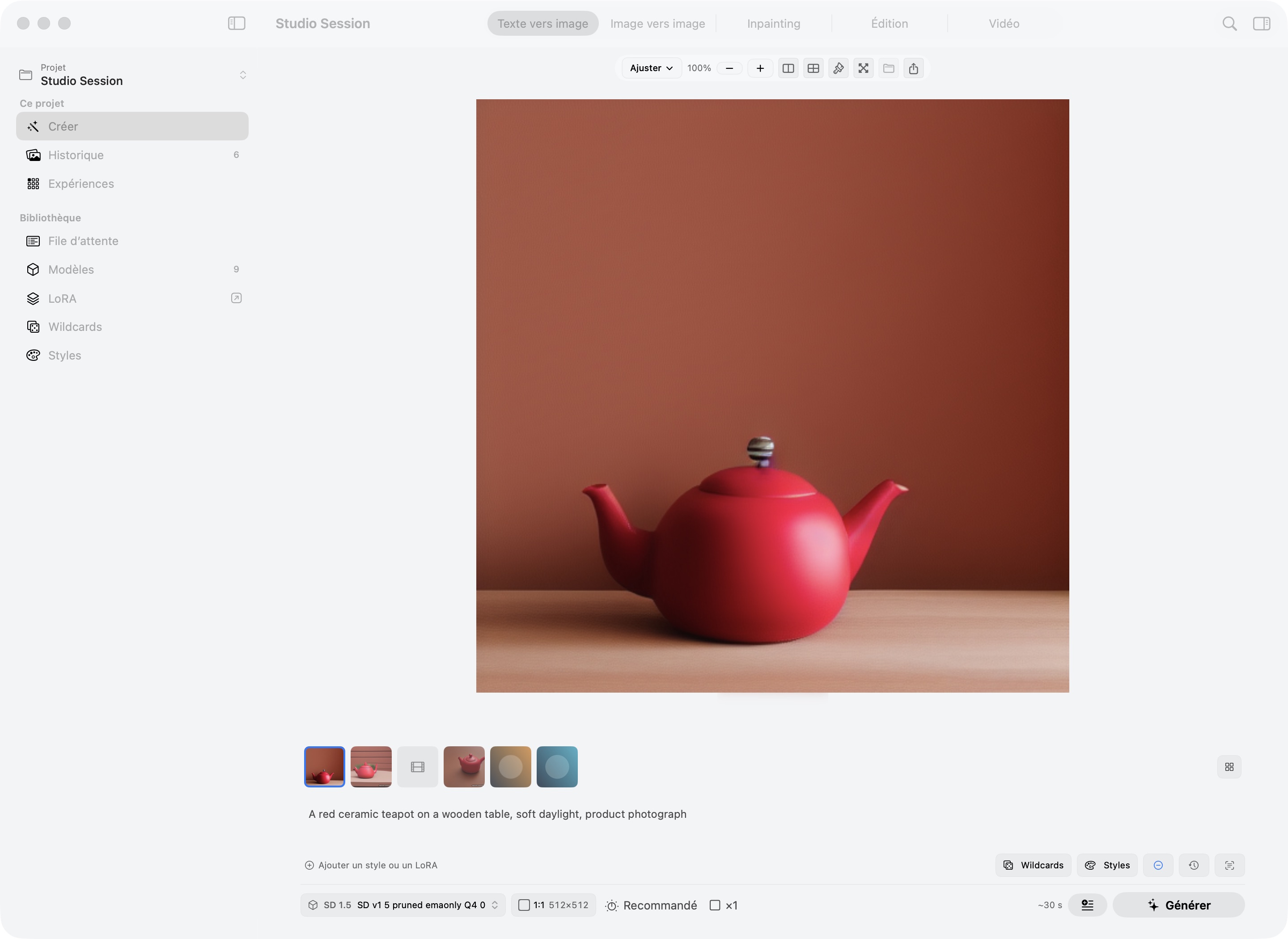
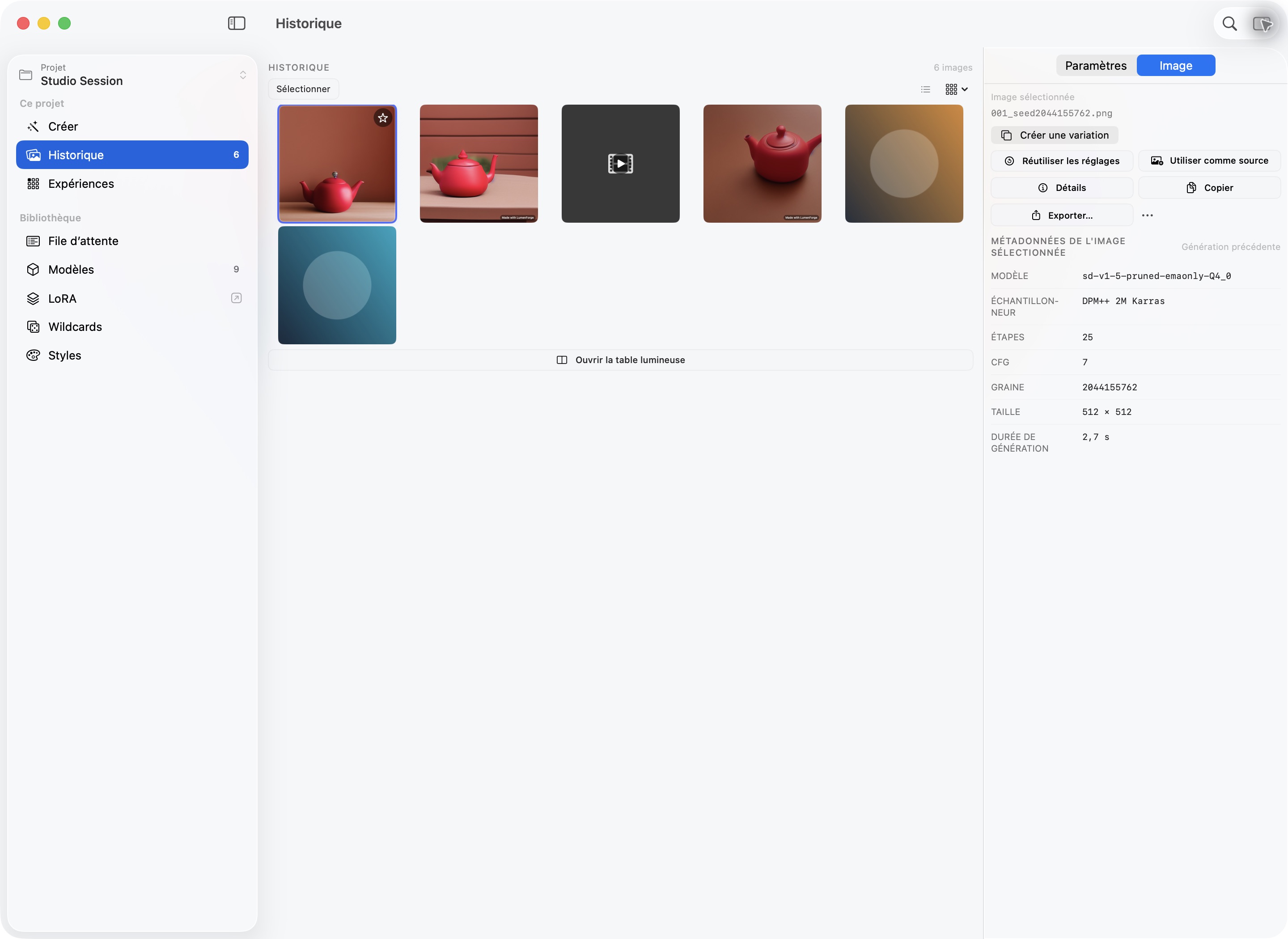
Current build 112 screens: the generation workspace, video mode and local library.

LumenForge image generation workspace with prompt and model controls
Build and run an image generation from one native workspace.
LumenForge video generation mode
Switch to video without changing tools or rebuilding the environment.
LumenForge local image browser
Review generations and their settings in the built-in browser.

Tools for the generation workflow

Most local image tools ask you to configure Python environments or tolerate web-based UIs. LumenForge is a proper macOS app that handles everything — from model detection to Metal GPU routing — so you can focus on generating.

Generation Engine

Every parameter, nothing hidden

Text to image. Image to image. Inpainting. All in the same workflow. The controls are full-featured without being overwhelming: sampler selection, step count, CFG scale, resolution up to 8192px, seed locking, batch generation, custom VAE override. Simple Mode is there if you want fewer knobs — full mode when you need them all.

  • 10+ samplers: Euler, DPM++ 2M/SDE, DDIM, UniPC, LCM, and more
  • Inpainting with a native mask editor — paint directly on your image
  • Batch generation with seed variation or fixed seed across a run
  • CFG scale 0–50, steps 1–200, CLIP skip 1–12
  • Tiled VAE for large resolution outputs without memory errors
  • Custom VAE override per generation
Text to Image Generate PROMPT A woman in a sunlit garden, impressionist painting style, soft bokeh FLUX Kontext (dev) DPM++ 2M · 28 steps CFG SCALE 7.5 SEED · 🔒 LOCKED RESOLUTION 1024 × 1024 Next in queue

Model Ecosystem

55 declared profiles, organised by the job.

The current repository contains adapters for the model families listed below and routes recognised files to a compatible inference engine. A safetensors file may use Diffusers or mflux; supported GGUF files use stable-diffusion.cpp with Metal; compatible MLX archives use Apple-silicon inference. Compatibility still depends on the exact architecture, quantisation and build, so an unknown model is not presented as universally supported.

  • FLUX dev, schnell, Kontext — state-of-the-art image quality via mflux
  • SDXL and SD 1.5 — broad LoRA ecosystem, fast iteration
  • Wan 2.2 and LTXV — text-to-video and image-to-video, local
  • GGUF quantized models — run large models (4-bit, 8-bit) on less RAM
  • MLX format — Apple Silicon native, fast and memory-efficient
  • Chroma, Lumina 2, Qwen Image, ERNIE, Z-Image, and more
FLUX SDXL Wan 2.2 LTXV GGUF MLX +12 more
Model Library + Add F FLUX Kontext Safetensors · 23.8 GB · Reference-conditioned FLUX XL SDXL 1.0 Base Safetensors · 6.9 GB · 2 LoRAs active SDXL Wan 2.2 (T2V) Safetensors · 14.2 GB · Video generation VIDEO Q8 FLUX.1-dev Q8_0 GGUF · 8-bit quantised · 9.8 GB · Metal GPU GGUF Q8 1.5 v1-5-pruned-emaonly.safetensors SD 1.5 · 3.97 GB

Edit Mode & Advanced Workflows

Reference images, ControlNet, LoRA, video

Edit Mode — available on FLUX Kontext, FLUX 2, Qwen, and Z-Image — lets you generate using reference images as visual anchors. The model attends to your references rather than blending them, so you get coherent outputs even when the prompt pushes in a new direction. For structure control, ControlNet guides generation with Canny edges, depth maps, or pose estimation.

  • Edit Mode: reference-conditioned generation, up to multiple input images
  • ControlNet: Canny edge, MiDaS depth, OpenPose preprocessors
  • LoRA blending: load multiple LoRAs, adjust per-weight strength
  • Wildcards: define variable prompt lists for batch variation
  • Video: T2V and I2V with Wan 2.2 and LTXV — queue overnight, no timeout
  • Prompt Enhancer: expand prompts locally with Ministral-3 (optional)
Edit Mode FLUX Kontext REFERENCE IMAGES Reference 1 Reference 2 + OUTPUT ACTIVE LoRAs portrait-v3 0.75 lighting-xl 0.50 Prompt wildcards: {sunrise|golden hour|soft morning} · Batch 4× Video: Wan 2.2 T2V · 4 sec · 24fps

Privacy & Architecture

Your Mac, your models, your images

Once compatible model files are present, generation, history, workspaces and the core UI can run without cloud inference. TestFlight needs Apple network access, and the optional starter-model download contacts Hugging Face when you explicitly request it.

  • Bundled Python 3.11 — no pip install, no conda, no setup scripts
  • Backend communicates over localhost only — App Sandbox enforced
  • No account, no login, no telemetry of any kind
  • User-managed compatible model files; the model publisher's licence still applies
  • All generation history stays in ~/Library/Application Support/LumenForge
  • Native Mac interface with a bundled, isolated runtime
Architecture · Localhost Only YOUR MAC SwiftUI Frontend Prompt, History, Canvas localhost Python 3.11 Backend FastAPI · SSE progress stream mflux FLUX family diffusers + MLX SDXL, SD 1.5… sd.cpp (Metal) GGUF quantised Local generation · App Sandbox · user-managed models

Up and running in three steps

No Python installation. No virtual environment. No shell scripts. One download, and you're generating.

1

Install LumenForge

Install the signed beta build supplied through the current release channel. The app bundle includes the runtime and inference dependencies, so you do not need to assemble a Python environment first.

2

Add your models

Obtain compatible model files from a source you trust and place them in your chosen models folder. LumenForge scans it on launch and detects supported architecture and format — safetensors, GGUF, or MLX. The Mac App Store profile uses these user-managed local files; any direct-build download option is documented by that build.

3

Generate

Write a prompt, pick a model, set your parameters, and hit Generate. Results appear in the canvas. Every image is saved to your history automatically. Use workspaces to keep separate projects organised — portraits, landscapes, a specific client brief — without mixing their histories or settings.

55 declared profiles, organised by the job.

LumenForge detects compatible files and routes them across three local inference paths. The number describes declared architecture profiles in build 112, not a promise that every checkpoint or quantisation will load.

Core imageSD 1.x / 2.x / 3.5, SDXL, FLUX, FLUX 2, Chroma, Z-Image, Qwen Image, Krea 2
Edit and controlFLUX Fill / Control / Kontext, Qwen Image, Z-Image, Krea 2, Mage Flow, LoRA and capability-matched ControlNet
Video and audioSVD, Wan / Wan 2.2, LTX / LTX-2.3, Hunyuan Video 1.5, MiniMax-H3 and LingBot Video
Formats and enginesSafetensors with Diffusers, compatible MLX with mflux, and quantised GGUF with stable-diffusion.cpp + Metal

Exact compatibility depends on the model family, required components, file layout, precision, available memory and this beta build.

Common questions

Help shape the Mac studio you want to use.

Build 112 is approved for external testing. Join the public TestFlight beta and run one real workflow now.

Join the global beta

Requires macOS 14 or later · Apple silicon (M1+) · 16 GB unified memory minimum