PulseWave / A practical guide
Rain, white noise or silence at bedtime?
Compare three bedtime sound options and adjust a background in the PulseWave mixer.
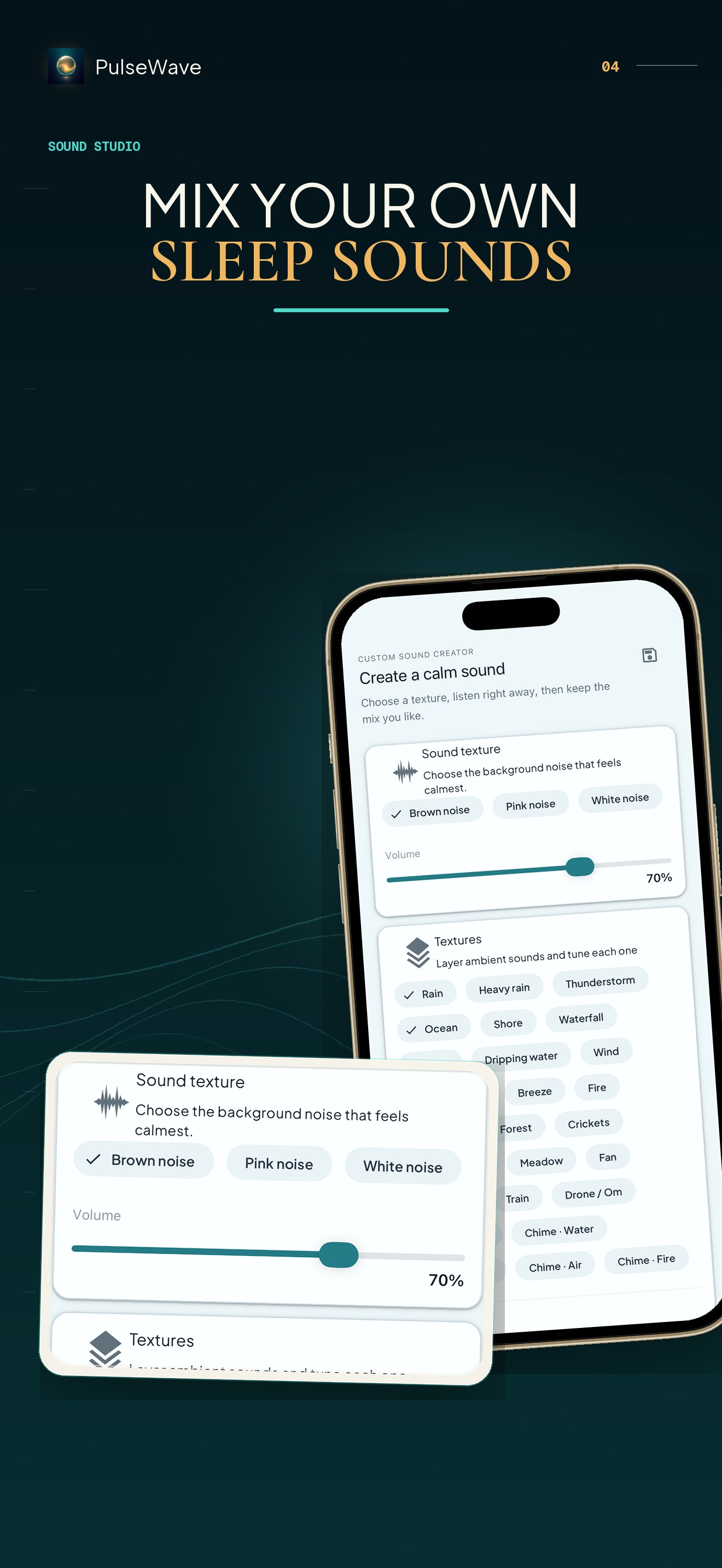
Rain gives you a recognizable texture. White noise gives you a steady broadband background. Silence leaves you with the sound already in the room. In PulseWave, you can compare different ambiences and, with the Premium mixer, adjust the layers. Listen to each option by itself before combining them.
Some nights the room is quiet until a car goes by. On others, the sound you keep noticing is the one you put on your phone. A steady background may make a passing sound stand out less. It can also make a quiet room feel busier. Spend a minute listening to the room from where you sleep before opening an app. You will have something to compare the added sound with.
Three choices for the same room
| Option | What it sounds like | When to change it |
|---|---|---|
| Rain | A natural texture, sometimes with audible drops, swells or loops | A particular sound keeps standing out from the background. |
| White noise | A continuous broadband hiss | You find the hiss distracting even at a low level. |
| Silence | The room as it is, with nothing playing | Intermittent outside sound keeps getting your attention. |
Rain and white noise can both sound continuous at first. Rain often has more variation. One drop may stand out or a loop may become familiar. White noise is more uniform, though its hiss may be exactly what you would rather remove. If you like rain by itself, leave it there. If the changing texture is what bothers you, try a steadier sound by itself. Keeping one layer makes the comparison easier and the setup easier to repeat.
What the studies measured
In a 2017 sleep-lab trial, Messineo and colleagues compared broadband sound with ordinary ambient noise in healthy adults. Participants went to bed 90 minutes early to create a temporary challenge falling asleep. The researchers observed a shorter time to stage 2 sleep in the broadband condition. The setup was specific. It did not compare rain with white noise or test either option in people’s bedrooms over several weeks. Messineo et al., Frontiers in Neurology.
Alvarsson, Wiens and Nilsson asked 40 participants to listen to nature sounds or environmental noise after a demanding arithmetic task. Skin conductance tended to recover faster with nature sound, while their heart-rate variability measure showed no effect. This was a study of recovery after a task. It did not measure time to fall asleep. The two studies ask different questions about sound, so their findings do not give rain or white noise a universal advantage at bedtime. Alvarsson et al., International Journal of Environmental Research and Public Health.
Set up your evening sound in PulseWave
Open PulseWave’s sound tools and start with a rain ambience or a steady noise. Set it low enough that you can leave it in the background. With the custom Premium mixer, adjust one layer before deciding whether you want to add a second. If the evening session offers a timer or a fade, choose when you want the audio to stop before putting the phone down.
Use the same device and place it in the same spot for the next comparison. Moving it closer and changing the volume at the same time makes it hard to tell which texture you preferred. The useful question the next evening is simple. Did you want to turn the sound down, switch textures or leave it alone while you got ready for bed? PulseWave gives you the controls to repeat the setup you liked. You can leave the room quiet on the nights it already sounds right.
Try PulseWave
Related reading · Compare silence, music and a mixed background for work.