PulseWave / A practical guide
EFT tapping vs. guided breathing for a short break
Compare a guided sequence of tapping points with a visual breathing timer for a short break.
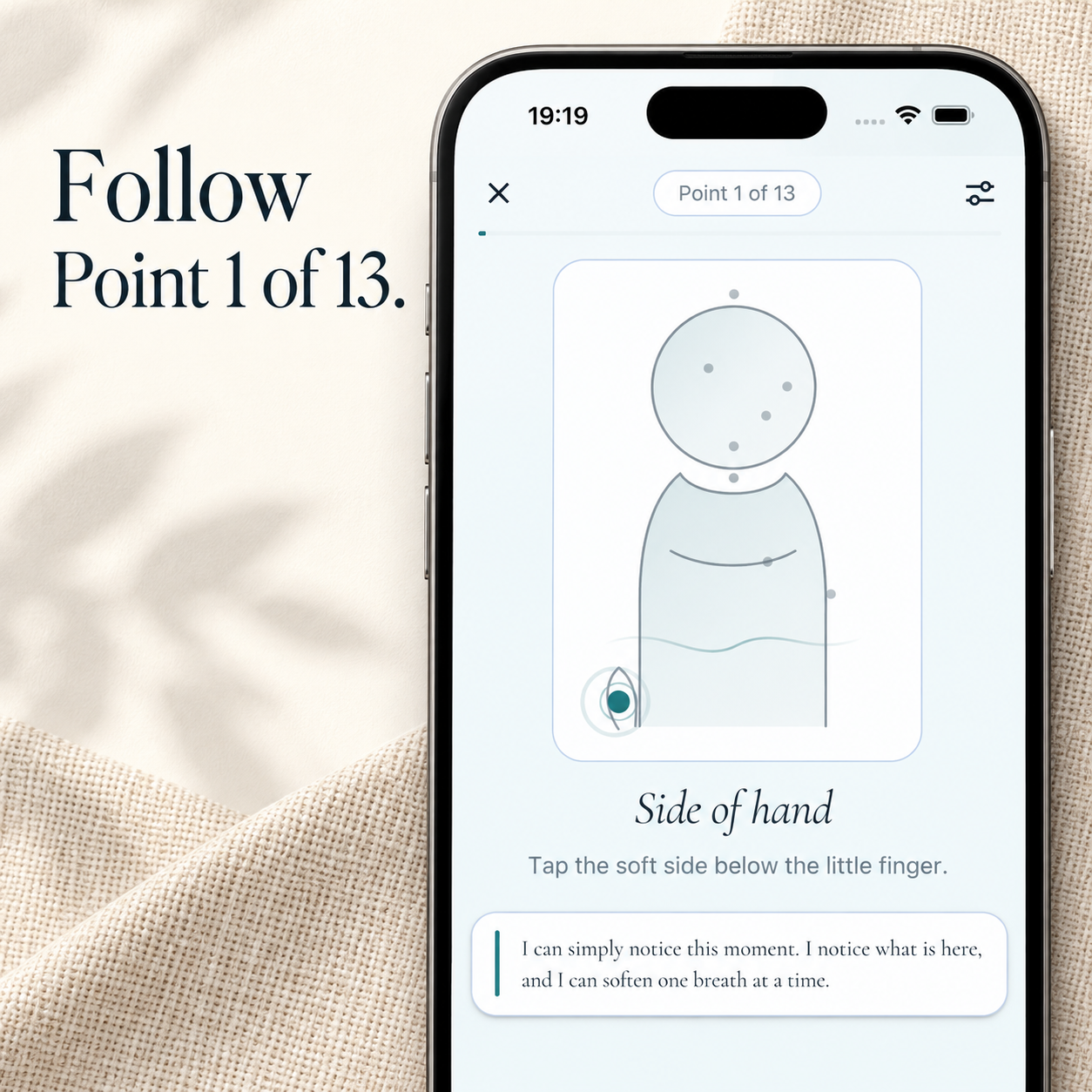
EFT tapping gives your hands a sequence to follow. Guided breathing gives you a pace to follow. Choose tapping when a physical cue is easier to focus on. Choose breathing when you would rather rest your hands and follow a visual timer. PulseWave offers both on mobile.
You close a video call. The next meeting starts in a few minutes, and one exchange from the last call is still running through your head. A break can be as simple as closing the laptop and getting up. If you would prefer something guided, the choice between tapping and breathing comes down to what you are willing to pay attention to. One uses a series of places on the body. The other uses the timing of a breath.
What do you actually do?
| Option | What you follow | When it might fit |
|---|---|---|
| EFT-style tapping | A sequence of points you tap lightly, with a cue or phrase | You want a concrete movement and an obvious next step. |
| Paced breathing | A cue that marks when to inhale and exhale | You want to rest your hands and let a timer carry the count. |
| An unguided break | Your own sense of when to return | You want a few minutes away from instructions and screens. |
EFT stands for Emotional Freedom Techniques. The research protocols generally combine tapping with a verbal or attentional task. The steps and the context differ across studies. In PulseWave’s guided tapping session, the first point shown in the iPhone capture is the soft side of the hand below the little finger. The screen names the point, shows where to tap and tells you where you are in the sequence. PulseWave’s Guided Reset gives you a fixed five-second inhale and five-second exhale instead.
What did researchers compare?
In 2003, Wells and colleagues randomly assigned 35 people with specific small-animal phobias to 30 minutes of EFT or diaphragmatic breathing. The EFT group improved more on a behavioral test and on several self-report measures. The between-group difference did not appear in pulse rate. The population, session length and outcome make this a study about a specific phobia, far removed from a brief break between calls. Wells et al., Journal of Clinical Psychology.
In 2020, Stapleton and colleagues randomized 53 participants to a group EFT session, psychoeducation or no intervention. The EFT group had a larger drop in salivary cortisol than the psychoeducation group. The difference relative to no intervention was not statistically significant, and self-reported distress did not mirror the cortisol result. Neither study tested PulseWave’s self-guided session or established what a single tapping point contributes. Stapleton et al., Psychological Trauma.
Compare the two breaks in PulseWave
For the tapping break, open Tapping and follow the first illustrated point. Tap lightly. Use the pause or finish control when you are ready to return to what you were doing. The useful part of the screen is the next instruction. You can start without memorizing the order of the points.
For the breathing break, choose Guided Reset and put the phone where you can see the orb. Let it cue the change in phase and keep the breath at a comfortable depth. If the tempo feels awkward, return to breathing normally. The timer gives you a clear endpoint. You can also take a short walk on a third day and see whether that suits the same gap better.
Compare these breaks after similar activities. Did you have to keep looking back at the tapping instructions? Did the orb make it easier to leave the clock alone? Either answer is enough to decide which tool to open next time. PulseWave handles the sequence and the count. You choose how to spend the pause.
Try PulseWave
PulseWave is made by High Road Software. Session availability can vary by platform and access level.
PulseWave on the App Store · PulseWave on Google Play · High Road Software
Related reading · Compare 5–5 breathing with a longer exhale.