PulseWave / A practical guide
A polished app can still launch to almost nobody.
PulseWave was live on three platforms. Two days of App Store data showed 473 impressions, one product page visit and no new downloads.
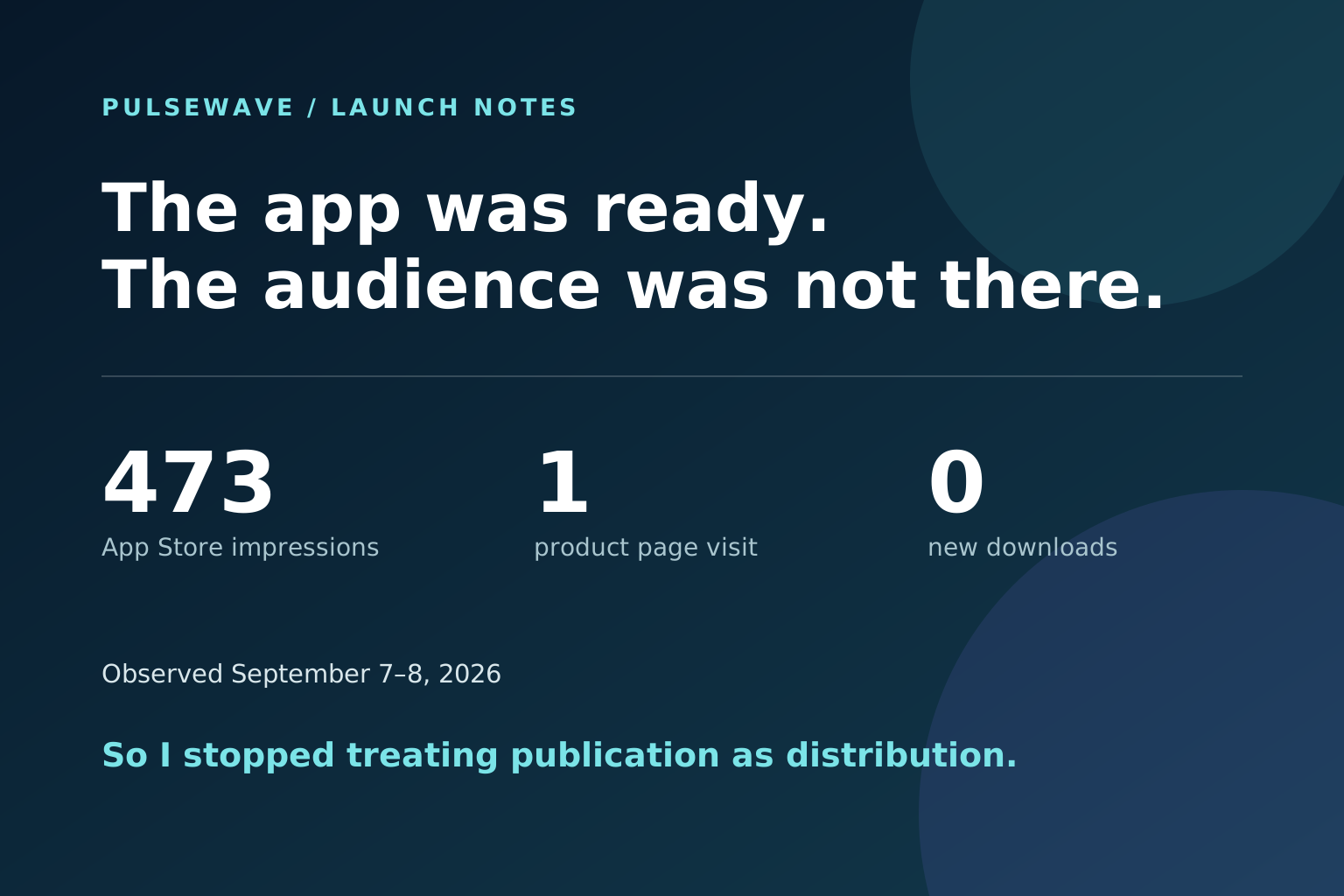
PulseWave was public on iPhone, Android and Mac. The product had been rebuilt, localized and polished. On September 7 and 8, 2026, its App Store listing received 473 impressions, one product page visit and no new downloads.
That was the useful number. It ruled out the comforting story that a good product eventually finds people on its own.
I had treated launch work as a sequence with a finish line. Build the app, make the store page, publish a few videos, contact some people, then wait for the graph to move. The app did ship. The audience did not appear.
Publishing to an empty account is barely distribution
The first social results were blunt. A PulseWave soundscape video on TikTok had no views after about 18 hours. The account had one follower. The same video had one like and no comments on Instagram. Reach and store clicks were unavailable, so I cannot turn those numbers into a conversion story. They only show that posting the asset was not enough.
The video itself demonstrated a real feature: Rain playing in the mixer, then Ocean added beside it. It was clear, short and technically sound. None of that supplied an audience.
This seems obvious when written down. It was less obvious while I was still busy improving transitions, checking every localized screen and making the product feel finished. Product work gives immediate feedback. Distribution work often gives silence.
The broad description hid the useful moments
PulseWave includes short guided resets, paced breathing, sleep audio, sound layering, guided tapping and private reflection. Listing all of that made the app accurate and forgettable at the same time.
People rarely wake up looking for a multi-feature wellness app. They want something for the moment in front of them. Thirty seconds between two tasks. Rain and ocean together while they read. A short routine before sleep. A guided rhythm when starting the next piece of work feels harder than it should.
I now treat each of those as a separate distribution lane. The app stays the same. The entry point changes with the conversation.
What I changed after the quiet launch
I stopped relying on the studio accounts to create their own reach. I started looking for recent conversations where someone had already described the exact moment PulseWave addresses. The first contribution should still be useful if the product name is removed. When PulseWave is relevant enough to mention, I say that I build it at High Road Software.
Editorial outreach became more specific too. A writer covering short pauses gets the 30 second Guided Reset. An app publication covering ambient audio gets the Rain and Ocean mixer. Each message refers to a specific article and one observable action inside the app.
I also need an owned record of the process. This article lives on the High Road Software site with a canonical URL, dated figures and links to the current product information. Shorter versions can travel to Medium, Substack and Reddit without pretending they are independent discoveries.
The measurement changed as well. An impression is not a store visit. A store visit is not a download. A download is not a completed reset, a second use or a subscription. The launch looked quiet because it was quiet. Combining those stages would only make the diagnosis harder.
The next test is about conversations, not posting volume
For the next two weeks, I am testing nine languages and several concrete situations. Some replies mention PulseWave. Most do not. The goal is to learn which problem earns a reply, a profile visit or a request for the app before making more content around it.
The same rule applies to articles. One useful source article can become a Substack note, a Medium version, a Reddit discussion, a short founder video and a pitch to a relevant newsletter. Copying the same introduction everywhere would create more URLs without creating more reasons to care.
If you are launching an app with no audience, I would write down four numbers before commissioning another campaign: how many people saw the store listing, how many opened it, how many downloaded and how many returned. Then choose one missing transition to work on. My missing transition was the first one. Almost nobody was reaching the page.
What I still do not know
I do not know whether the free 30-second reset, the sound mixer or the sleep routines will become the strongest way into PulseWave. I also do not know whether founder stories will reach future users or mostly other developers.
That uncertainty is now part of the work instead of a reason to polish in private for another month. The next useful signal is small: one person describing the moment they would open the app, one qualified store visit, one first reset completed.
You can read the current PulseWave product page and the privacy details. The public App Store listing is linked below.