PulseWave / A practical guide
How to Feel Better in 2027: Build a Daily Routine You Can Actually Keep
A little breathing room, one useful note, and a plan that still fits an ordinary Tuesday.
January has a way of turning a perfectly reasonable wish into a rather demanding project. You would like to feel a bit better. Suddenly, there is a new morning routine, a reading list, a tracker, and a small mountain of things to buy.
For 2027, try starting with one moment you would like to make easier. The ten minutes after work, perhaps. Or the gap between closing your laptop and opening another app on your phone. A routine becomes easier to shape when you can point to the part of the day it belongs to.
Choose a moment you already have
Think about yesterday. Where was there a small opportunity to pause? It might have been while the kettle boiled, after a meeting, or before you climbed into bed. Choose a moment that happens often enough to become familiar.
Write a plain sentence: “After I close my work laptop, I will sit down for a short pause.” Keep the action small enough to try on a busy day. You can lengthen it later if you enjoy it. There is no need to design the ideal version before you have tried the ordinary one.
Give that pause a physical home. A chair, a quiet corner, or the edge of the garden will do. Making fewer decisions at the start can be useful: you already know where to go and what you meant to do.
Let the pause be comfortable
You might spend it looking out of the window, listening to something gentle, or following a breathing guide. For a breathing exercise, sit comfortably and let the breath stay easy. The NHS breathing guide recommends gentle, regular breathing without forcing its depth or pace. A counting pattern is optional; comfort comes first.
A timer can take care of the clock. Start with a duration you are willing to try, then let it finish without adding a second task. If a particular rhythm feels uncomfortable, stop following it and return to your usual breathing. Persistent distress or symptoms deserve support from a qualified health professional.
The useful question afterwards is modest: “Would I like to make room for that again?” A pause does not need to produce a dramatic feeling to have a place in your day.
Leave yourself a note you can understand tomorrow
If you like keeping a journal, begin with a sentence rather than a page. “I was still thinking about the meeting.” “The walk was the best part of today.” “I could use some company this weekend.” Those notes give your next decision a little context.
You can also skip the note. Reflection should leave you with something useful, not another form to complete. If recording your mood makes you inspect every small change, a simpler habit may suit you better.
When a journal lives in an app, check where entries are stored and whether cloud sync is optional. A private moment deserves a clear answer about its data. Keep other people's personal details out of casual notes unless you have a good reason to record them.
Make room for something beyond a screen
An app can guide a pause or hold a note. Your day also needs space for people, interests, and activities that matter to you. The NHS wellbeing guidance includes connection, movement, learning, kindness, and attention to the present among the areas worth exploring.
Choose one thing you would look forward to. Invite someone for a walk. Pick up an instrument you have left alone. Make something with your hands. Let the choice come from curiosity rather than a plan to become impressive by February.
You might even use the note from your pause to choose it. “I could use some company” can become a message to a friend. “I miss making things” can become half an hour with a sketchbook. The routine has then helped you notice a next step.
Where our experience fits
We make PulseWave, which brings guided breathing, listening sessions, and mood check-ins into one app. These are ways to structure a moment; the experience remains yours. Some content is included when you start, and the deeper library has Premium options.
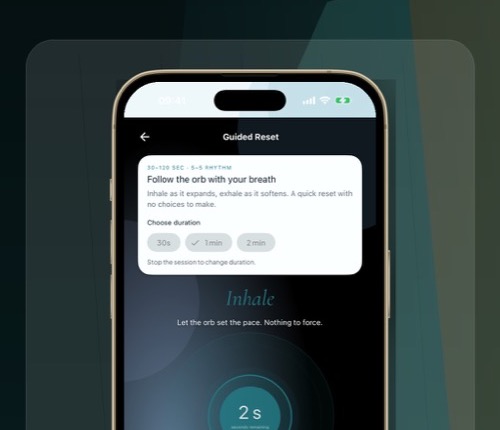
The real interface pictured here shows a guided pause with short duration choices. PulseWave's separate journal and mood entries stay on the device by default; cloud sync requires separate consent. Its account and subscription services have their own data needs, described in the privacy information. That boundary matters more than a broad promise that an app knows what will make you feel better.
You can try the free breathing timer in your browser before choosing an app. A paper notebook and a clock are perfectly reasonable companions too.
Try it before the new year
Choose one existing moment, one comfortable pause, and one optional sentence. Give that arrangement a few ordinary days. If it fits, keep it. If it feels awkward, change the moment or the activity.
You can arrive in 2027 with something familiar already waiting for you: a small piece of the day that you chose, and permission to make it your own.
2027 planning edition. Product information and linked guidance checked on 26 October 2026. Image: real PulseWave Guided Reset interface from an existing High Road Software product capture.