PulseWave / A practical guide
Cardiac coherence starts with a rhythm, not a promise
What slow breathing changes while you practice, what researchers actually measure and why six breaths per minute became a common reference point.
Cardiac coherence is often introduced as a list of benefits
Less stress. More calm. Better sleep. Sharper focus
That list arrives too early. Before wondering what a breathing practice might change, someone trying it for the first time needs to know what to do for the next few minutes
The basic action is easy to describe: slow the breath and follow a steady rhythm. In a 5–5 pattern, the inhale lasts five seconds and the exhale lasts five seconds. One full cycle takes ten seconds, which gives six breaths per minute
The rhythm does not guarantee a particular feeling. It gives the practice a clear shape and makes it easier to understand how breathing and heart-rate variation can move together
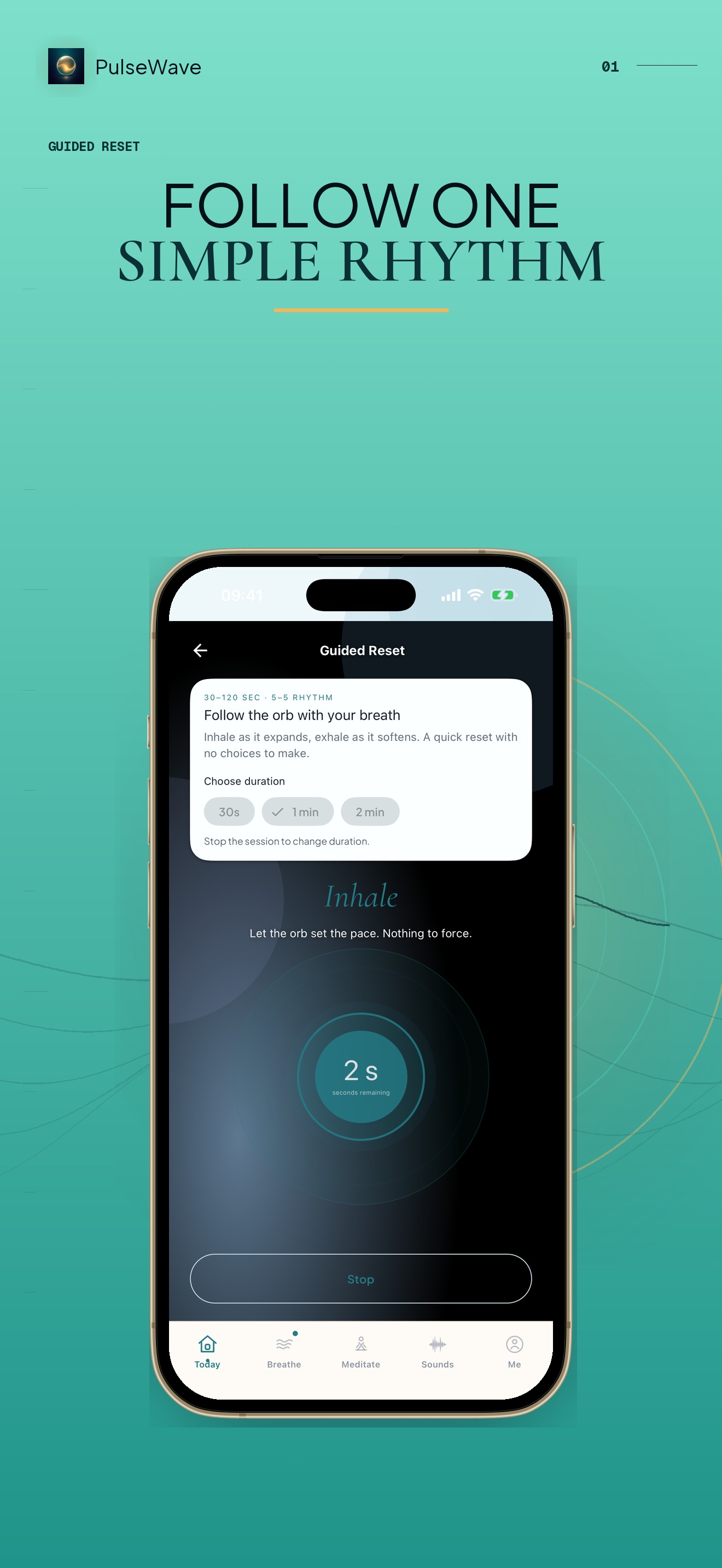
That distinction shaped Guided Reset while I was building it at High Road Software. Each session begins with a concrete action: follow the orb for the chosen duration
The heart does not beat like a metronome
The interval between two heartbeats changes all the time. This variation is called heart rate variability, usually shortened to HRV
Breathing contributes to those changes. In many people, heart rate rises slightly during the inhale and falls during the exhale. The mechanism is called respiratory sinus arrhythmia, a name that sounds far more alarming than the ordinary process it describes
When breathing becomes slow and regular, variations linked to the respiratory cycle can become larger during the session. A 2022 meta-analysis brought together 223 studies of voluntary slow breathing. On average, vagally mediated HRV measures increased during slow breathing, immediately after a first session and after interventions made up of repeated sessions. Those three findings were not supported by the same number of studies
This is a physiological result observed across groups. It cannot predict how one person will feel after a few minutes
Six breaths per minute is a reference point, not a universal setting
The 5–5 pattern is popular because it is simple to understand and easy to guide. It also sits close to a range commonly used in slow-breathing and HRV biofeedback research
In HRV biofeedback, practitioners may look for an individual's resonance frequency instead of setting every person to six breaths per minute. A 2023 methodological review also found that studies often reported too little detail about breathing duration, the inhale-to-exhale ratio, how breathing was controlled and body position
That lack of detail matters. Two sessions both labelled cardiac coherence can ask for different actions. One may use equal inhales and exhales. Another may lengthen the exhale. A third may adapt the pace from a live measurement
Without a sensor, 5–5 remains a readable place to start. It removes the arithmetic and makes it easier to notice whether the pace feels comfortable or forced
Slower does not mean bigger
The phrase “deep breathing” can make people try to fill their lungs completely. That extra effort can turn a simple rhythm into a performance
The aim is to keep each breath ordinary. An ordinary inhale over five seconds, followed by an ordinary exhale over five seconds, is enough to follow the cycle. Your shoulders have nothing to prove. Your stomach does not need to become an anatomy demonstration
A 2018 review of the psychophysiological effects of slow breathing retained fifteen studies that met strict criteria from more than two thousand records screened. It reported autonomic, brain and psychological changes, while noting that the exact mechanisms remain under discussion and that protocols differ widely
Studies can measure physiological changes during slow breathing more precisely than they can describe what every individual experiences in the moment
A useful practice fits inside one instruction
Good guidance should not ask someone to count, read, watch the clock and interpret their state at the same time
A circle that expands and contracts may be enough. A vibration at each change of phase can help when the screen is out of view. A quiet sound can carry the pace in another way
That is the logic behind PulseWave's Guided Reset. It offers a 5–5 rhythm in 30, 60 or 120-second sessions. Longer breathing sessions are available when someone wants to spend more time with the practice
The short duration keeps the decision small: choose a time, follow the rhythm and reach the end
Cardiac coherence then becomes less mysterious. One inhale, one exhale, ten seconds in total, and the cycle begins again
Choose a duration, follow the 5–5 rhythm and reach the end of the session.